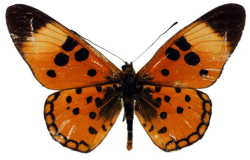
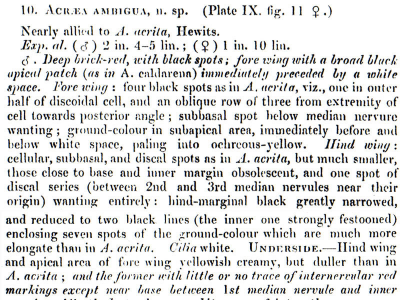
INFORMATIONS DETAILLEES SUR LA DESCRIPTION ET SUR SA CLASSIFICATION
Description
ambigua
Auteur
Trimen
Date
1891
Décrit comme
Acraea ambigua
Lieu du Type
Kap-Stadt, Coll. Trimen (Eltringham, 1912)
Localité Type
Ehanda, Okavango river
Référence
Proc. Zool. Soc. Lond.: 70, pl. 9, fig. 11
Titre de la Source
On Butterflies collected in tropical South-Western Africa, by Mr. A. W. Eriksson
Publication
Proceedings of the Zoological Society of London
Classification proposée aujourd'hui
Classé comme
Species
Espèce
ambigua
Sous-espèce
ambigua
Sous-genre
Acraea (Acraea)
Clade
II3a
Groupe
egina
Observations et histoire de la classification de la description
Aurivillius (1898) classifies ambigua as an aberration of Hewitson’s acrita. Strand (1910) classifies it as a variety of acrita. Neave (1910) asserts the distinctiveness of ambigua. Eltringham (1912, 1916) classifies ambigua as a subspecies of acrita. Le Doux (1932) retains the subspecies status of ambigua, whilst noting that Eltringham confused acrita and ambigua. Carcasson (1961) expresses doubts about the validity of this subspecies. van Son (1963) classifies ambigua as a subspecies. Carcasson and Ackery (1981) do the same. According to Pierre (1987), there is undoubtedly some confusion between ambigua and eltringhamiana Le Doux, described later. He considers that the status of ambigua remains uncertain, but classifies this taxon as a synonym of acrita. Specimens associated with ambigua are found in western Zambia and form a transition with bellona Weymer. Gardiner & Bernaud (2026) show that ambigua is the species of the acrita group from Angola and classify bellona as a synonym.