INFORMATIONS DETAILLEES SUR LA DESCRIPTION ET SUR SA CLASSIFICATION
Description
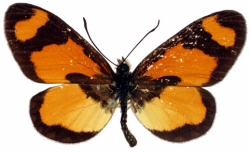
alicia
Auteur
Sharpe
Date
1890
Décrit comme
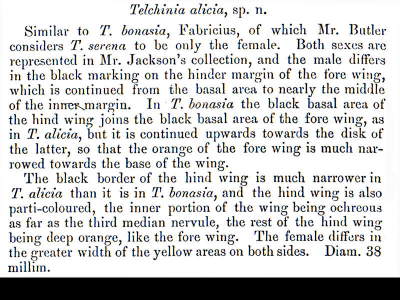
Telchinia alicia
Lieu du Type
Coll. Jackson (Eltringham, 1912)
Localité Type
Ukambani country
Référence
Ann. Mag. Nat. Hist. (6), 5: 442
Titre de la Source
Description of new species of East African Butterflies
Publication
The Annals and Magazine of Natural History, London
Classification proposée aujourd'hui
Classé comme
Species
Espèce
alicia
Sous-espèce
alicia
Sous-genre
Acraea (Actinote)
Clade
I5c
Groupe
bonasia
Observations et histoire de la classification de la description
Jordan (1905) classified alicia as a subspecies of bonasia Fabricius. Aurivillius retained its status as a species (1906, 1910), a view shared by Poulton (1908), Heron (1909), Grünberg (1910) and Rebel (1911). Eltringham (1912, 1916) linked alicia to bonasia, assigning it the rank of subspecies. Aurivillius adopted this view in 1922. Ungemach (1932) confirmed this position on the basis of the Abyssinian populations. Carpenter (1935) followed this view. Dufrane (1945) held the same view. Overlaet (1955) considered that it was hardly possible to separate all specimens into two clearly distinct groups and, as the two forms had been captured together in several localities, alicia could only be regarded, for the Upemba region, as a form falling within the limits of bonasia’s variability. Carcasson (1961), for his part, maintains that alicia is a valid subspecies. Carcasson and Ackery (1981) take the same view. Some authors (Kielland) record alicia from Cameroon to Tanzania, whilst others (Pierre) consider it to be a species confined to eastern Africa. Pierre (1985) clearly classifies alicia as a distinct species. Bernaud, Lequeux & Ziraye (2019) classify alicia as a form of bonasia ( ... Voir Texte complet