INFORMATIONS DETAILLEES SUR LA DESCRIPTION ET SUR SA CLASSIFICATION
Description
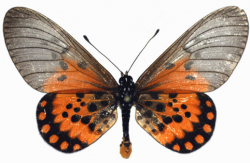
admatha
Auteur
Hewitson
Date
1865
Décrit initialement comme
Acraea admatha
Lieu du Type
London (Eltringham, 1912)
Localité Type
Nigeria (Old Calabar)
Référence
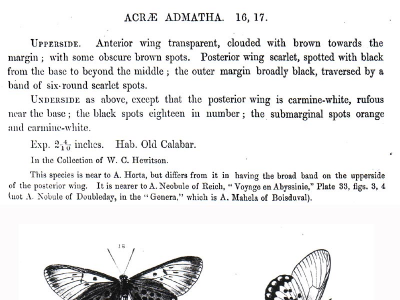
Exot. Butt. (Acraea) 3: 15, pl. 8, fig. 16, 17
Titre de la Source
Publication
Illustrations of new species of exotic butterflies
Classification proposée aujourd'hui
Considéré comme
Espèce
Espèce
admatha
Sous-espèce
admatha
Sous-genre
Acraea (Acraea)
Clade
II4b
Groupe
neobule
Observations et histoire de la classification de la description
Plusieurs espèces ont été confondues sous ce nom (voir endoscota, leucographa, boopis, etc.), ce qui a généré de nombreuses confusions quant à la répartition géographique de l'espèce. Eltringham (1912) classe cette espèce dans son groupe III, et relève l'inconstance des caractères, sans pouvoir lier certaines formes à certaines régions. Ce n'est qu'à compter des travaux de Pierre (1979) sur ce groupe que de nombreuses pro-species seront identifiées, admatha restant confinée dans la zone nigerio-camerounaise.